
Table of Contents
We’re used to hearing about red flags — those warning signs telling us to slow down, step back, reconsider. But there’s another side to the story that often gets overlooked: green flags in relationships, those positive behaviors that signal you might actually be onto something real and worth building. Not signs of perfection — nobody is — but signs of health, respect, and genuine potential.
Learning to recognize green flags is especially valuable if you’re navigating dating through a queer, non-binary, or non-monogamous lens. The relationship models mainstream culture offers us often don’t reflect our realities — which makes it even more important to have our own touchstones for what “healthy” actually looks like.
This guide walks through the key green flags to look for in a relationship, with a specific eye on queer and polyamorous dynamics. Not a rigid checklist to anxiously tick off, but a set of tools to help you navigate with more clarity and confidence.
💭 When I Finally Understood What “Healthy” Felt Like
My name is Alex, I’m 29, I identify as non-binary, and I’ve been consciously exploring polyamory for about three years. For a long time, I confused intensity with health — I thought a relationship was only “real” if it kept me up at night, if it was complicated and full of tension. Then I met someone who, during our first real argument, paused, took a breath, and said: “I need a moment. Let’s talk after.” That sentence threw me more than any romantic gesture ever had. It was a green flag — it just took me weeks to recognize it as one.
What Exactly Are Green Flags in Relationships?

A green flag is a behavior or quality that signals someone has the tools to build a healthy, mature, and respectful relationship. It’s not the absence of problems — it’s the presence of the capacity to navigate them well.
As researchers at Johns Hopkins University Student Well-Being point out, green flags and red flags can coexist in the same relationship — and the presence of positive signs doesn’t automatically erase the negative ones. This is crucial: it’s not about tallying up a final score, but about understanding the overall direction of things.
According to research from the Gottman Institute, stable and happy couples maintain a ratio of at least 5 positive interactions for every 1 negative during conflict. That doesn’t mean no clashes or friction — it means there’s enough positive foundation to absorb them. That’s the difference between a relationship that sustains you and one that slowly erodes you.
The Core Green Flags Worth Recognizing
Psychological research consistently points to a handful of qualities: open communication, active listening, boundary respect, and genuine support for each other’s personal growth.
Communication without fear of judgment. This is one of the most underrated green flags. It’s not about talking a lot — it’s about being able to say difficult things without bracing for a disproportionate reaction. A partner who holds space for hard conversations and doesn’t weaponize your vulnerabilities later is showing fundamental emotional maturity.
Pacing and boundary respect. As noted in a piece on Psychology Today, the willingness to accept mutual influence — allowing yourself to be shaped by the other person without losing yourself — is one of the strongest predictors of long-term relationship satisfaction. A partner who slows down when you slow down, who doesn’t push when you’re not ready, is someone you can actually build something with.
Genuine support for your growth. Not a partner who merely tolerates your ambitions, but one who actively wants you to flourish — even when that means time apart, energy invested elsewhere, or personal paths that don’t involve them. Jealousy toward your goals isn’t love: it’s control wearing a softer mask.
Repairing after conflict. No couple is conflict-free. The green flag isn’t the absence of arguments — it’s the ability to come back toward each other after them. A partner who can genuinely apologize, acknowledge their part, and work to avoid repeating the same pattern is offering something rare and valuable.
Green Flags in Queer and Polyamorous Relationships
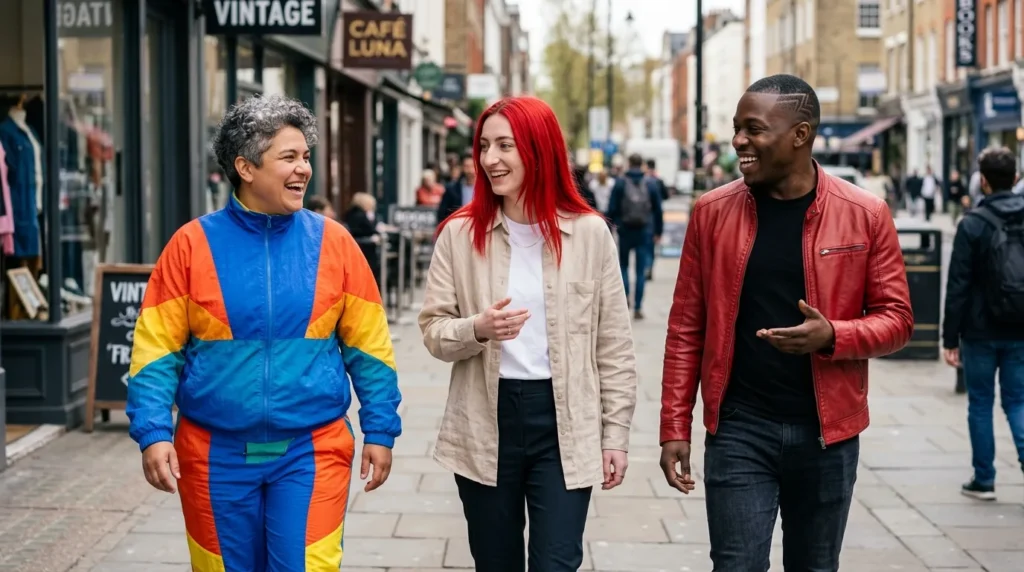
In queer and non-monogamous relationships, there are additional green flags worth watching for: identity affirmation, structural transparency, and compersion — the genuine joy felt at a partner’s happiness with others.
Anyone navigating queer relationships knows there are extra layers to consider. According to Thrive Counseling Center, in LGBTQ+ relationships one of the most significant green flags is affirmation of gender identity and orientation — not as an act of tolerance, but as genuine respect. A partner who consistently uses your correct pronouns, who won’t out you without consent, and who doesn’t make you feel like “too much” for who you are, is demonstrating foundational respect.
In polyamorous contexts, green flags take on additional nuance. As explored on Discovering Polyamory, a healthy polyamorous partner is someone who is comfortable being alone — who values solitude rather than using relationships to escape from unresolved personal issues. This, combined with proactive and honest communication about expectations and relational structures, forms the foundation of everything else.
Compersion — that feeling of joy you experience when a partner is happy with someone else — is often cited as an advanced green flag in polyamory. You can’t fake it, and not everyone experiences it all the time. But a partner who is genuinely glad about your other connections, rather than viewing them as threats, brings something profoundly healthy to the dynamic.
How to Train Yourself to Spot Green Flags in Real Life
Recognizing green flags takes practice, especially if you’ve come from relationships where unhealthy behaviors were normalized. The process is about observing patterns over time — not first impressions.
One of the main risks when you start looking for green flags is confusing them with love bombing: overwhelming enthusiasm in the early stages that then quietly disappears. The difference lies in consistency. A green flag isn’t an isolated gesture — it’s a pattern. Someone who really listens, every time. Someone who respects your boundaries, even when it costs them something.
A useful practice is watching how someone handles small everyday frustrations. How do they treat service workers? How do they react when plans change at the last minute? How do they talk about their exes? These micro-behaviors often reveal more than any romantic declaration.
Finally, one often overlooked green flag: how do you feel when you’re with that person? Not just excited — but safe. Free to be yourself without calculating every word. That sense of expansion, rather than contraction, is perhaps the most reliable signal of all.
Conclusion
Green flags in relationships aren’t markers of a perfect relationship — they’re your compass toward relationships worth building. Honest communication, respect for boundaries, authentic support for growth, and the capacity to repair after conflict: these are the building blocks of something real and lasting.
For those moving through queer or polyamorous spaces, identity affirmation and transparency around relational structures add further dimensions. Don’t settle for the mere absence of red flags: actively look for the presence of green. Because you deserve someone who makes you feel at home — not someone you’re always trying to survive.
💡 Want to put these tips into practice?
Join GoGay.Dating and start meeting people who share your values and interests.
30-day free trial!
✍️ By the GoGay Editorial Team
The news.gogay.dating editorial team shares authentic experiences from the LGBTQ+ community. Find out more →